
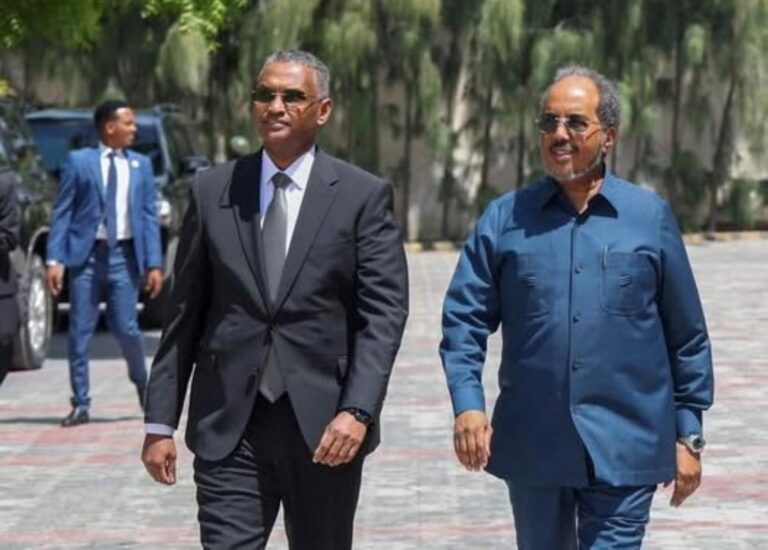
MOGADISHU, Somalia – Somalia’s political elite is again locked in mistrust as allies who helped President Hassan Sheikh Mohamud return to power now question his leadership, exposing fractures in his circle as the country battles al-Shabaab and faces an uncertain electoral future.
Mohamud returned to office in 2022 promising unity, political reconciliation and an aggressive offensive against the extremist group.
But allies who once helped secure his comeback are turning against him amid accusations of centralized decision-making and political exclusion.
The uncertainty followed the expiration of his four-year mandate on May 15 without a clear electoral transition plan.
Somalia’s opposition leaders warn the country risks entering another prolonged political crisis driven by elite power struggles.
Several influential figures have already distanced themselves from President Mohamud, criticizing what they describe as shrinking political consultation.
Among them are Abdirahman Odawa, a former secretary of Mohamud’s party, and former intelligence chief Abdullahi Sanbaloolshe.
Both men have become vocal critics of Mohamud’s governing style and expanding influence over regional political processes.
Attention has now shifted toward Mahad Salad, director of Somalia’s National Intelligence and Security Agency (NISA).
Mahad’s political ambitions in Galmudug state have placed him on a direct collision course with Mohamud.
The dispute centers on upcoming leadership elections in Galmudug, a strategically important regional state in central Somalia.
Mohamud’s rivals accuse him of backing businessman Liban Shuluq, a close ally of the president, for regional leadership.
The allegations have escalated tensions among senior officials and widened mistrust inside Somalia’s fragile political establishment.
“This is becoming an internal fracture, not simply an opposition challenge,” political analyst Ali Guleid said.
“When presidents begin losing confidence from their own allies, the political consequences can escalate very quickly,” he added.
Critics say Mohamud’s moves in Galmudug resemble previous disputes in South West State, where regional leader Abdiaziz Laftagareen was forced to step down and later fled to Kenya.
Regional leaders have accused Villa Somalia of heavily influencing leadership outcomes through pressure and political maneuvering.
The Galmudug tensions have reportedly angered incumbent regional President Ahmed Abdi Kariye, widely known as Qoor-Qoor.
Allies of Qoor-Qoor accuse the federal government of interfering directly in the state’s internal political affairs and succession discussions.
Prime Minister Hamza Abdi Barre, politically close to Mahad Salad, is also reportedly uncomfortable with Mohamud’s support for Shuluq.
The row has fueled speculation about widening divisions between Somalia’s top political and security leadership circles.
Analysts warn the divisions could weaken coordination against al-Shabaab during a crucial phase of Somalia’s military campaign.
Mahad Salad’s authority inside NISA may already have been quietly reduced, according to sources.
Political insiders say some intelligence units were instructed to report directly to another senior official.
Neither Villa Somalia nor NISA has publicly commented on the claims or reports of internal disagreements.
“Somali politics has always depended on fragile alliances shaped by clan interests and shifting loyalties,” political researcher Osman Ali said.
“Once key allies feel excluded from decision-making, tensions spread quickly throughout the political system,” he added.
Galmudug remains politically critical due to its role in military operations against al-Shabaab and wider Hawiye power dynamics.
The state also carries symbolic importance in Mogadishu politics, where competition among Hawiye leaders shapes national calculations.
Analysts fear prolonged infighting could derail Somalia’s delayed constitutional reforms and disputed electoral transition.
“The risk is that leaders become consumed by political survival instead of national security priorities and timely elections,” security analyst Asha Osman said.
“At a moment requiring consensus toward elections and unity against al-Shabaab, Somalia’s leadership appears embroiled in power struggles,” she added.
For Mohamud, the greatest threat may no longer come from formal opposition groups but from restless allies within his own coalition.