
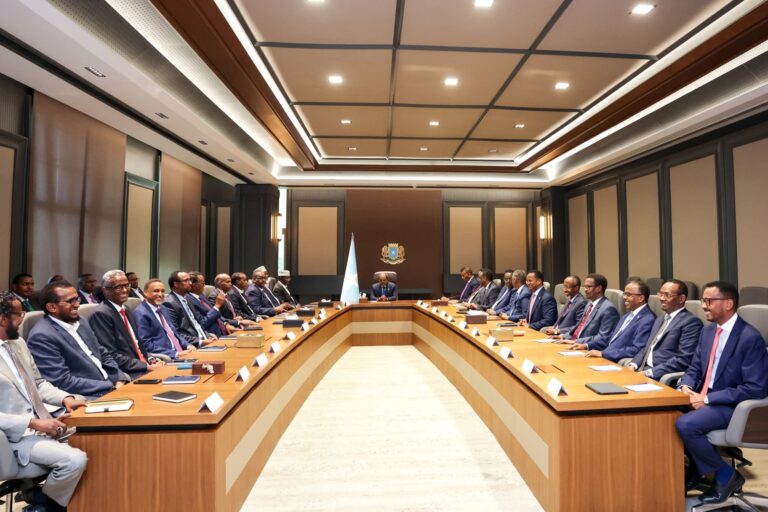
MOGADISHU, Somalia — Political rivals who once traded accusations — and, in some cases, gunfire — gathered Thursday inside the presidential palace, signaling a rare show of unity and dialogue.
With three months left before Somalia’s federal institutions’ mandate expires, President Hassan Sheikh Mohamud welcomed regional leaders and opposition figures for talks aimed at breaking a long-running stalemate over electoral reforms.
Among those at the table was Ahmed Madobe, president of Jubaland state. His re-election on Nov. 25, 2024, had been rejected by the federal government over alleged violations of the unified electoral process.
The meeting marked a striking turnaround for leaders whose disputes had stalled progress and erupted into deadly violence in Raskamboni, Lower Jubba, under Madobe’s jurisdiction.
The deployment followed an arrest warrant issued by a Mogadishu court, charging Madobe with treason and violations of the electoral process.
Sensing a threat to his leadership, Madobe deployed his own troops and defeated the federal forces after heavy fighting that left dozens of soldiers dead.
Now, Madobe sits alongside Mohamud as a recognized regional leader, negotiating what kind of electoral model Somalia should adopt for the first time in decades.
Dispute Over Election Model
Mohamud has pushed sweeping reforms aimed at a unified, more direct voting system. But Madobe, Puntland President Said Abdullahi Deni, and opposition leaders have rejected the plan, favoring a return to Somalia’s traditional clan-based indirect voting.
Somalia has not held a nationwide one-person, one-vote election in decades. Instead, clan elders select lawmakers, who in turn choose the president — a system designed to balance clan representation.
“The core issue is trust,” said Ali Osman, a Somali political analyst in Mogadishu. “Regional leaders fear that rapid electoral changes without consensus could centralize power and destabilize fragile federal systems.”
Asha Farah, a Horn of Africa expert, said stakes are high. “If there is no agreement, Somalia risks repeating the 2021 crisis, when disputes over electoral reforms triggered armed confrontations in Mogadishu.”
She said Somalia cannot afford another breakdown amid al-Shabab threats and economic hardship.
“Seeing these leaders in one room is historic,” said Feisal Guleid, political analyst based in Mogadishu, emphasizing the stakes of dialogue.
“It’s not merely a negotiation,” he added, “but a critical test of whether Somalia’s federalism can survive without returning to large-scale violent conflict again.”
Echoes of 2021
The current standoff mirrors 2021, when then-President Mohamed Abdullahi Mohamed’s attempt to extend his mandate and implement reforms collapsed, sparking violence in the capital.
At that time, Mohamud — then an opposition figure — rejected the reforms, arguing they lacked consensus. Now, as president, he faces similar resistance from the same regional leaders.
Talks are ongoing in Mogadishu, but it remains unclear whether Mohamud will compromise on his vision for unified elections or whether regional leaders will soften their stance.
“The symbolism of this meeting is important,” said Farah. “But symbolism alone is not enough. Somalia needs a negotiated settlement that preserves federal unity and political stability.”
Without agreement, analysts warn, the country could once again slide into confrontation — a prospect many Somalis fear after years of political paralysis, violence, and missed opportunities for reform.