
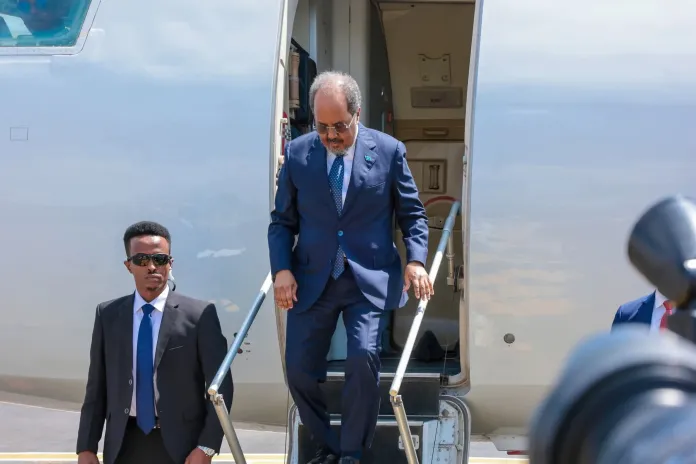
MOGADISHU, Somalia — Somalia’s federal system faces renewed challenges as President Hassan Sheikh Mohamud returns from Ethiopia, amid political tensions over elections, power-sharing, and constitutional reforms.
The nation stands at a pivotal political crossroads, with citizens watching closely how federal leaders and opposition members handle the upcoming talks in Mogadishu.
President Mohamud is reportedly preparing to meet regional state leaders, including those from Jubaland and Puntland, to address disputes over elections and proposed amendments to the provisional constitution.
However, the planned meeting faces obstacles, including disagreements over the venue. Jubaland President Ahmed Madobe and Puntland President Said Deni are reportedly reluctant, fueling mistrust.
Madobe and Deni have booked a hotel within the Halane compound, home to the U.N., U.S. Embassy, AU, and other foreign missions, and remain hesitant to leave. They want talks held inside the compound.
Tensions emerged after President Mohamud pushed constitutional changes to implement his plan for unified elections, while Madobe and Deni rejected the reforms, demanding a return to indirect voting.
“Elections are not the only issue. The future of federalism also matters,” said analyst Ali Hassan, noting the central challenges facing the government. Trust between the federal government and regional states appears strained, risking fragile cohesion and complicating consensus-building.
The debate over the meeting venue shows mistrust of centralized authority, with some leaders viewing the presidential palace as a symbol of dominance rather than collaboration within Somalia’s federal system.
Diplomats and civil society leaders warn that prolonged political division could extend beyond politics, undermining security operations and slowing the country’s long-delayed institutional reforms.
“The country has made hard-won gains,” said a Mogadishu-based civil society organizer. “If leaders focus only on power struggles, ordinary citizens will inevitably pay the price.”
For many Somalis, constitutional amendments and electoral debates may feel abstract, yet these negotiations could determine how leaders are chosen and how power is shared for decades.
With three months left in President Mohamud’s term, Somalia waits to see whether he will compromise, abandon his push for unified elections, and lead the country toward indirect voting to prevent further division.