
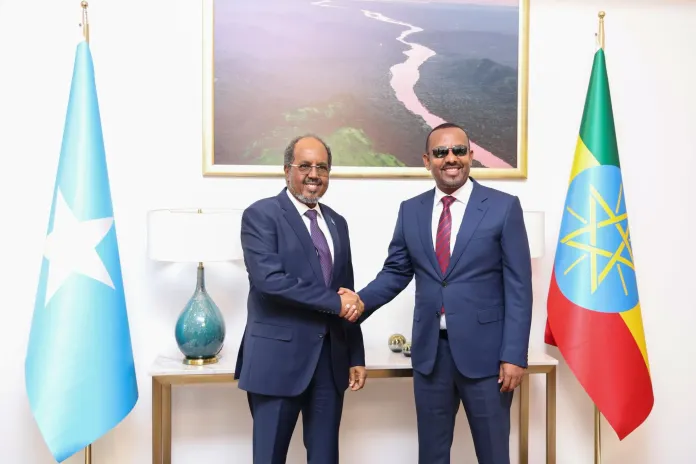
ADDIS ABABA, Ethiopia — Somali President Hassan Sheikh Mohamud arrived in Ethiopia on Friday at the invitation of Prime Minister Abiy Ahmed to strengthen ties and promote stability in the Horn of Africa.
Mohamud was warmly received at Addis Ababa’s airport and later held talks with Abiy at his office. They discussed ways to deepen cooperation on security, trade, and regional development.
Abiy said the meeting “built on last year’s discussions and progress in strengthening our cooperation and focused on advancing shared priorities and stability in the region.”
Friday’s visit comes days after Ethiopia released footage of Indian Prime Minister Narendra Modi’s visit to Addis Ababa on Wednesday. The video drew criticism for including a map that showed Somalia as part of Ethiopia.
Back in Somalia, Mohamud faces growing political pressure. Opposition leaders, along with the presidents of the semi-autonomous Jubaland and Puntland regions, gathered in Kismayo to discuss the country’s political crisis and upcoming elections.
Mohamud has advocated for a “one person, one vote” electoral system, a reform intended to expand public participation. The opposition rejects the proposed changes, citing concerns about fairness and transparency.
They also allege Somalia’s election commissioner is closely aligned with the presidency, raising doubts about the process’s impartiality. Mohamud’s supporters say the reforms are necessary to modernize Somalia’s democracy.
Political analysts question Mohamud’s vision for a direct election, noting that he himself was elected indirectly on May 15, 2022, when he defeated Mohamud Abdullahi Farmaajo. They point out that while in opposition, he rejected similar reforms proposed by Farmaajo, only to now push for the same changes.
Opposition leaders accuse Mohamud of attempting to extend his time in office and dismantling government institutions. “We are witnessing an unprecedented crisis, where the very institutions holding the country together are being eroded,” they said.
Analysts say Mohamud faces challenges similar to those of Farmaajo, whose electoral proposals were rejected, leading to an indirect presidential election. Questions remain whether Mohamud will compromise and lead Somalia to an indirect election for the greater good.
Somalia has never had a nationwide electoral system. Since General Siad Barre took power in 1969, clan affiliations have largely determined political positions, including president, prime minister, and parliamentary leadership. Both houses of Parliament, which elect the president, are composed of members selected by clan delegates rather than direct vote. Clan influence has shaped Somalia’s political landscape for decades.