
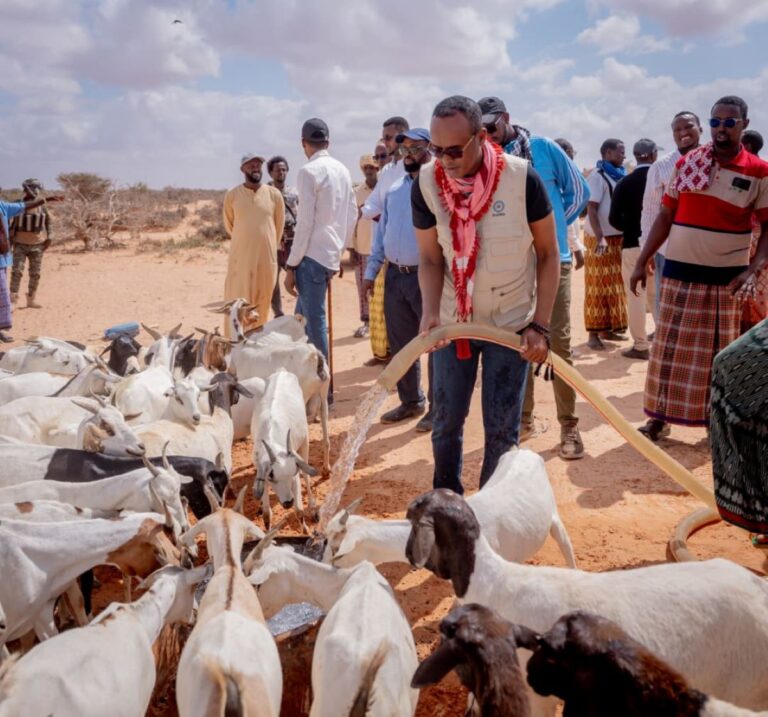
MOGADISHU, Somalia — In the dusty plains of central Somalia, the earth has cracked open under a relentless sun. Wells that once sustained villages now sit dry and hollow. Livestock carcasses lie scattered across shrinking pastureland. And in many homes, there is nothing left to cook.
While wells lie empty, the Somali National Disaster Management Agency (SoDMA) urges Somalis to pause and reflect, focusing on the suffering caused by the ongoing drought across rural communities nationwide.
Mahmoud Moalim, SoDMA’s chairman, spoke with visible frustration during a drought relief mission in Mudug, criticizing lavish public iftar gatherings in Mogadishu that overshadow compassion and urgent humanitarian needs.
“It is heartbreaking,” Abdulle said. “We see families who have no clean water, no food, no livestock left. Yet in the capital, money is being spent on a such gathering. We cannot feast publicly while our people are suffering in silence.”
Across Somalia, repeated failed rains have withered crops and emptied vital water sources. For pastoralist families reliant on livestock, this crisis has taken not only income, but also dignity.
In Wisil district, Moalim delivered 125 water tankers to parched rural communities, revealing the scale of suffering. Women queued for hours under scorching heat, clutching empty containers, while children waited, faces etched with exhaustion.
“Our animals are dying one by one,” said a father of five who lost most of his goats this season. “When the animals die, our life dies with them. Now even water is something we beg for.”
He said families walk miles every day in search of drinkable water. Some have abandoned their villages entirely, moving toward overcrowded towns. Makeshift shelters now dot urban outskirts, where displaced families cling to hope for assistance.
“The drought does not knock before it enters your home,” Moalim said. “It takes your animals, your crops, your savings — and then it tests your faith.”
He also questioned the timing and priorities of public iftar celebrations in Mogadishu, reminding citizens that true generosity comes through helping those in need.
“Ramadan is about sacrifice and solidarity,” he said. “If we are blessed with wealth, then this is the time to redirect it to those whose children sleep thirsty.”
Humanitarian agencies warn that without ongoing rainfall and increased funding, food insecurity in Somalia could worsen. Repeated climate shocks, from parched lands to floods, have left Somalia extremely vulnerable.
For families in remote villages, however, the crisis is not measured in reports or projections. It is measured in empty water containers and silent cooking pots.
As he concluded his visit, Moalim called for unity beyond words.
“This is not about politics. It is about humanity,” he said. “A nation is tested by how it stands with its weakest. Right now, our people need more than prayers. They need action.”