
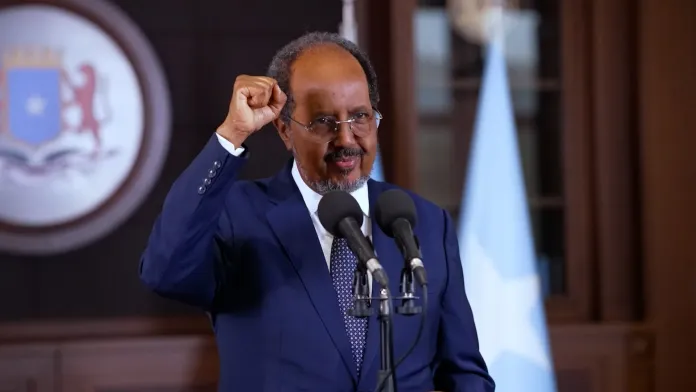
MOGADISHU, Somalia — Somalia’s political crisis is no longer confined to disputes over election dates and constitutional amendments. It has become a confrontation over the authority and independence of the country’s most powerful institutions.
The Supreme Court’s decision to declare the mandates of the president, Parliament and federal government expired has brought an already divided political landscape into uncharted territory.
The ruling directly challenges President Hassan Sheikh Mohamud’s administration, raising fundamental questions about constitutional authority, the separation of powers and the legitimacy of decisions made by federal institutions.
The court ruled that the mandates of both chambers of the Federal Parliament and the federal government ended April 14, 2026, while Mohamud’s presidential term expired May 15.
It also declared subsequent actions by those institutions invalid, directing them to operate within caretaker responsibilities while the country seeks a political settlement.
In an effort to break the deadlock, the court ordered the establishment of an electoral framework within 30 days and elections within 90 days.
The judgment represents a major intervention by the judiciary in a political dispute that has increasingly divided Somalia’s federal leadership, opposition groups and federal member states.
The constitutional battle
At the center of the legal dispute is a petition filed by former President Sharif Sheikh Ahmed, challenging the procedures through which Somalia’s Provisional Constitution was amended.
Sharif asked the Supreme Court to examine whether the amendments were adopted in accordance with constitutional requirements and whether decisions arising from them were legally valid.
He argued that the changes lacked the necessary legal procedures and sufficient political agreement among the country’s major political stakeholders.
The amendments are particularly consequential because they affect the terms of the president and federal lawmakers, alongside arrangements governing the country’s electoral system.
The federal government has defended the changes, describing them as necessary reforms providing a legal framework for Somalia’s political transition.
Opposition leaders have rejected that position, arguing that fundamental constitutional and electoral decisions require broader political consensus rather than unilateral government action.
The disagreement has widened beyond Mogadishu, drawing in federal member states whose leaders have also challenged the revised constitutional framework.
Presidency and judiciary collide
The legal dispute took a more confrontational turn when President Mohamud dismissed Supreme Court Chairman Baashe Yusuf Ahmed and appointed his legal adviser Ibrahim Idle Suleiman to replace him.
Mohamud justified the decision by citing complaints from judges, judicial employees and legal professionals about the administration of justice.
In a statement, he said the leadership change was part of broader efforts to strengthen judicial institutions, improve transparency and ensure impartiality.
However, the timing raised questions because the Supreme Court was simultaneously considering Sharif’s politically sensitive petition challenging the constitutional amendments.
The court rejected Mohamud’s decision to remove Baashe, declaring his dismissal null and void and challenging the presidency’s authority over its leadership.
It accused Mohamud of attempting to obstruct proceedings involving fundamental constitutional questions and the mandates of the country’s highest political institutions.
At stake is not simply the position of a Supreme Court chairman, but the ability of Somalia’s highest judicial body to independently scrutinize the country’s political leadership.
Security forces enter the dispute
The political and legal confrontation escalated further Thursday when security forces reportedly stormed the Supreme Court building in Mogadishu.
The incident involved Baashe, who was addressing journalists when security personnel confronted him inside the court premises.
The operation followed his rejection of the presidential decision to remove him, which the Supreme Court had already declared invalid.
The circumstances surrounding the operation, including who authorized the deployment and the status of the court’s leadership, have become important questions requiring clarification.
An election without political consensus?
The Supreme Court confrontation is unfolding alongside a wider struggle over how Somalia should organize its next elections.
The federal government has continued advancing constitutional and electoral changes, maintaining that they are necessary to establish a new political system.
The opposition, however, argues that the government cannot unilaterally determine the country’s political future through contested constitutional amendments and electoral arrangements.
Some federal member state leaders have also rejected the revised framework, calling for negotiations to resolve disagreements with the federal government.
Sharif has warned that proceeding without an inclusive political agreement could deepen divisions and produce competing claims to political authority.
Meanwhile, Mogadishu has increasingly become the center of the standoff, with political disagreements accompanied by security deployments and disputes over opposition activities.
The central challenge is therefore much larger than selecting an election date. It is finding an electoral process that competing political actors recognize as legitimate.
Without agreement on the rules governing the transition, even an election could become another source of political confrontation rather than a mechanism for resolving the crisis.
A dangerous test of institutional independence
The confrontation presents Somalia with one of its most consequential institutional tests in recent years.
The presidency, Parliament and judiciary have distinct constitutional responsibilities, but the current dispute has exposed disagreements over the boundaries of their respective powers.
The Supreme Court was expected to provide a legal avenue for resolving questions surrounding constitutional amendments and the decisions taken under them.
Instead, its confrontation with the presidency has created another institutional crisis, further complicating efforts to reach a political settlement.
The implications extend beyond the immediate dispute. Somalia continues to face security challenges, including its fight against al-Shabab, alongside humanitarian and economic pressures.
A prolonged political standoff risks diverting government attention from these priorities and weakening cooperation among institutions responsible for national security and governance.
Ultimately, Somalia’s crisis is about more than who occupies the presidency or when the next election takes place. It concerns whether the country’s institutions can operate within constitutional limits.
The outcome could determine whether Somalia moves toward a negotiated political settlement or enters a deeper confrontation over the legitimacy and authority of the state.