


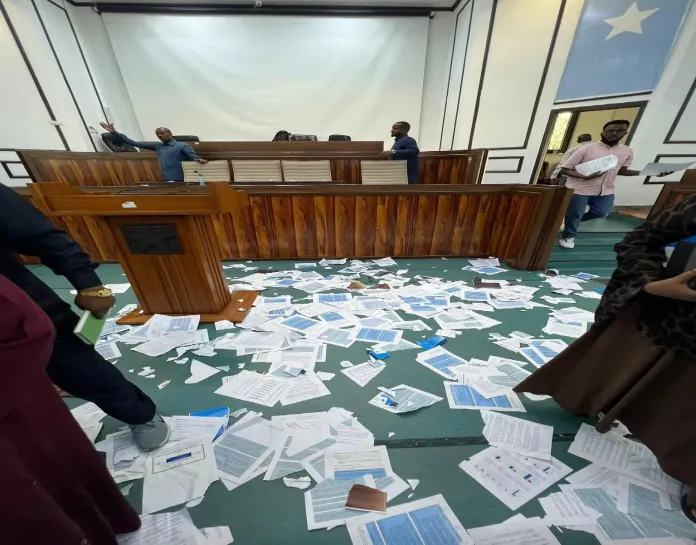
MOGADISHU, Somalia — Somalia’s parliament plunged into chaos Wednesday as lawmakers ripped up agenda papers, halting debate over constitutional amendments backed by President Hassan Sheikh Mohamud.
The disorder erupted after MPs received the debate agenda, with shouting, whistles and disruptions quickly overwhelming proceedings inside the parliamentary chamber.
Video footage showed Security Minister Abdullahi Sheikh Ismail Fartag exchanging punches with MP Hassan Firinbi, highlighting the intensity of confrontation over the proposed changes.
As tensions escalated, lawmakers tore up agenda papers, forcing the speaker and his deputies to walk out and abruptly end the session.
The amendments are championed by President Mohamud, who says they enable governance reforms and pave the way for one person, one vote elections.
Opponents accuse the president of pushing constitutional changes for political gain, particularly as he has roughly three months remaining in his term.
Opposition leaders condemned the proposals despite planning to meet the president next week in an attempt to reach consensus on elections.
President Mohamud continues advocating direct elections despite security challenges, limited preparations and opposition warnings that the timeline is unrealistic and destabilizing.
“These amendments risk centralizing power in Mogadishu at the expense of the regions,” said governance analyst Faisa Ismail, citing resistance from MPs and federal states.
Leaders of the federal member states of Jubaland and Puntland have also rejected earlier amendments, arguing they undermine Somalia’s federal system.
Somalia’s provisional constitution, adopted in 2012, was intended to be finalized through an inclusive national process involving broad political consensus.
However, repeated delays, political infighting and persistent security concerns have stalled progress, making constitutional reform one of Somalia’s most contentious issues.
Wednesday’s scenes of disorder represented one of the most serious breakdowns of parliamentary decorum in recent years.
Analysts warn escalating confrontations could delay electoral preparations and distract leaders from urgent security challenges, including the fight against al-Qaida-linked al-Shabab.
“When parliament collapses into physical confrontation, it weakens public confidence in state institutions,” said political analyst Mohamed Ibrahim.
He added that such chaos complicates efforts to promote major reforms, including direct elections, to an already skeptical population.
There was no immediate response from Speaker Aden Madobe’s office following the incident.
It remains unclear when parliament will reconvene or whether the proposed constitutional amendments will be reintroduced.
For now, the chaotic session underscores growing uncertainty surrounding Somalia’s constitutional future as political divisions deepen ahead of a critical electoral period.